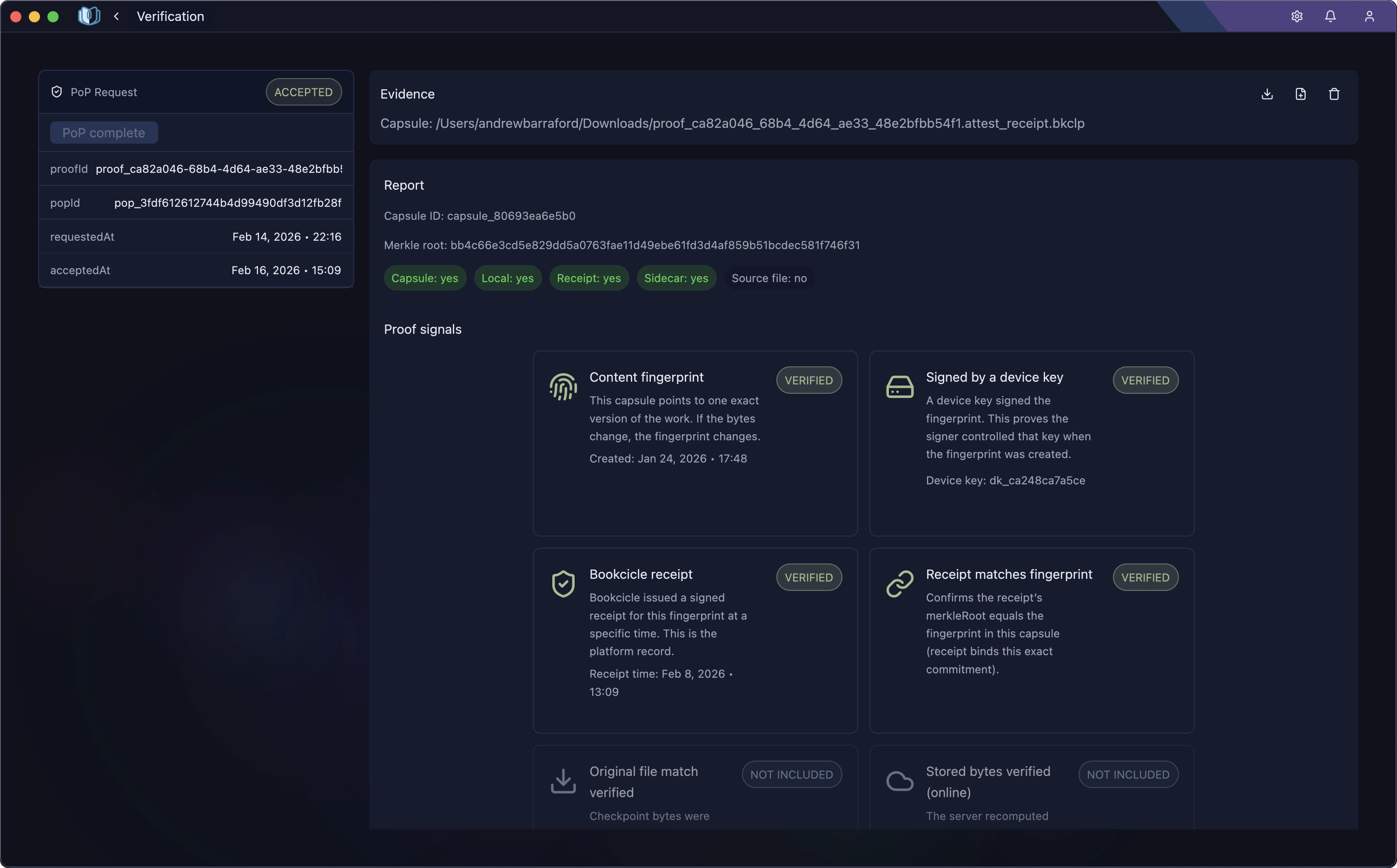
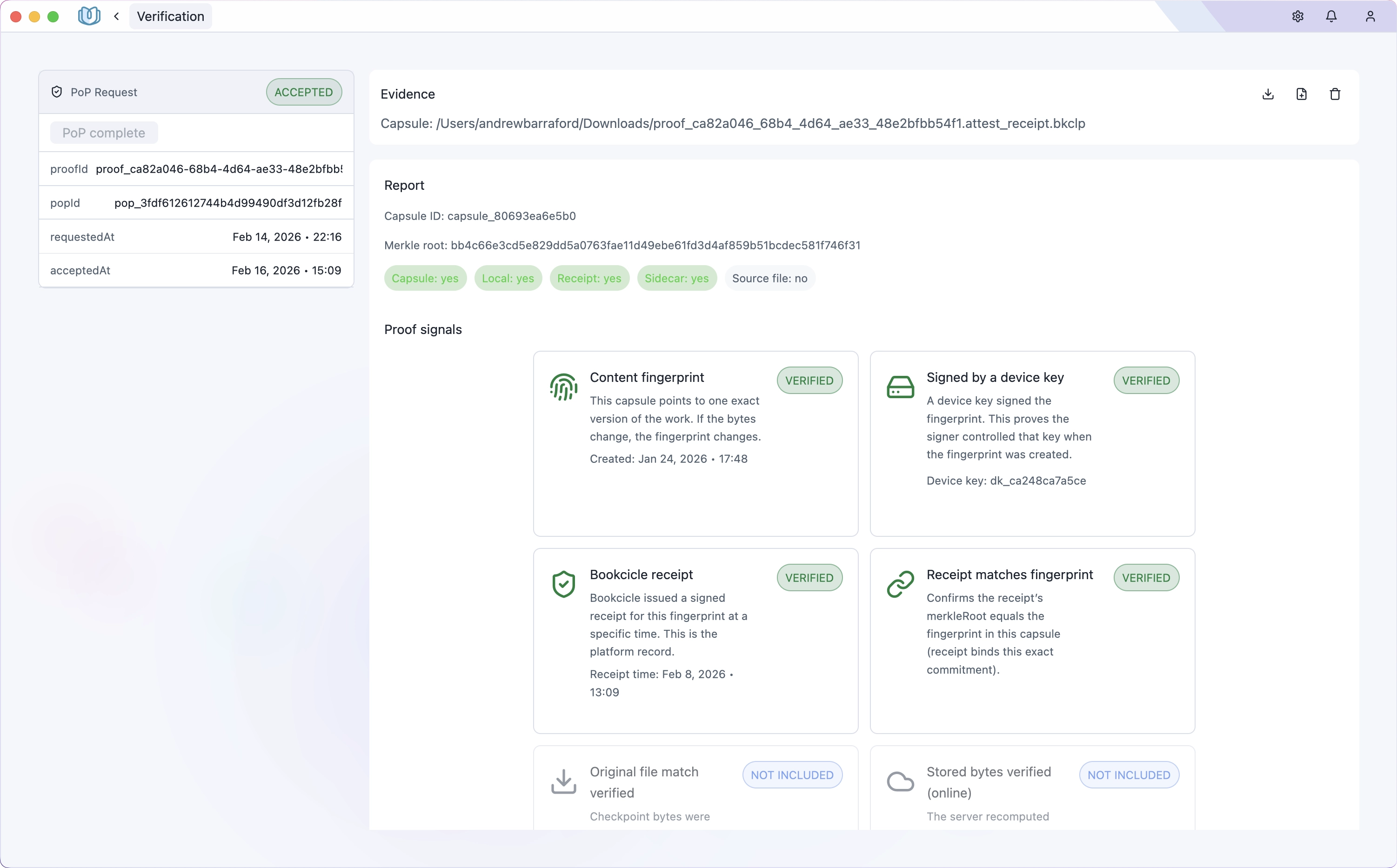
Notary gives your work provenance you can prove.
In a Bookcicle project, local proofs can be created directly in the browser for drafts, uploads, history snapshots, exports, and collaborator handoffs. Bookcicle can then attest those local receipts in the cloud and optionally anchor signatures publicly for a stronger timestamp over time.
Notary produces cryptographic receipts that bind content bytes to timestamps and signers. This creates verifiable provenance for milestones, outputs, AI transforms, and contributor handoffs.
Multiple humans and AI systems can touch the same artifact. Notary helps create verifiable checkpoints around authorship, handoffs, and revisions without relying on screenshots or informal history.
Every service can export a .bkclp proof capsule. Anyone can verify later using the capsule plus the content bytes (embedded or provided).
Where Notary fits inside Bookcicle projects
Notary is not a separate product you have to manage. It is an evidence layer across project history, collaboration, downloads, AI-assisted work, and final delivery.
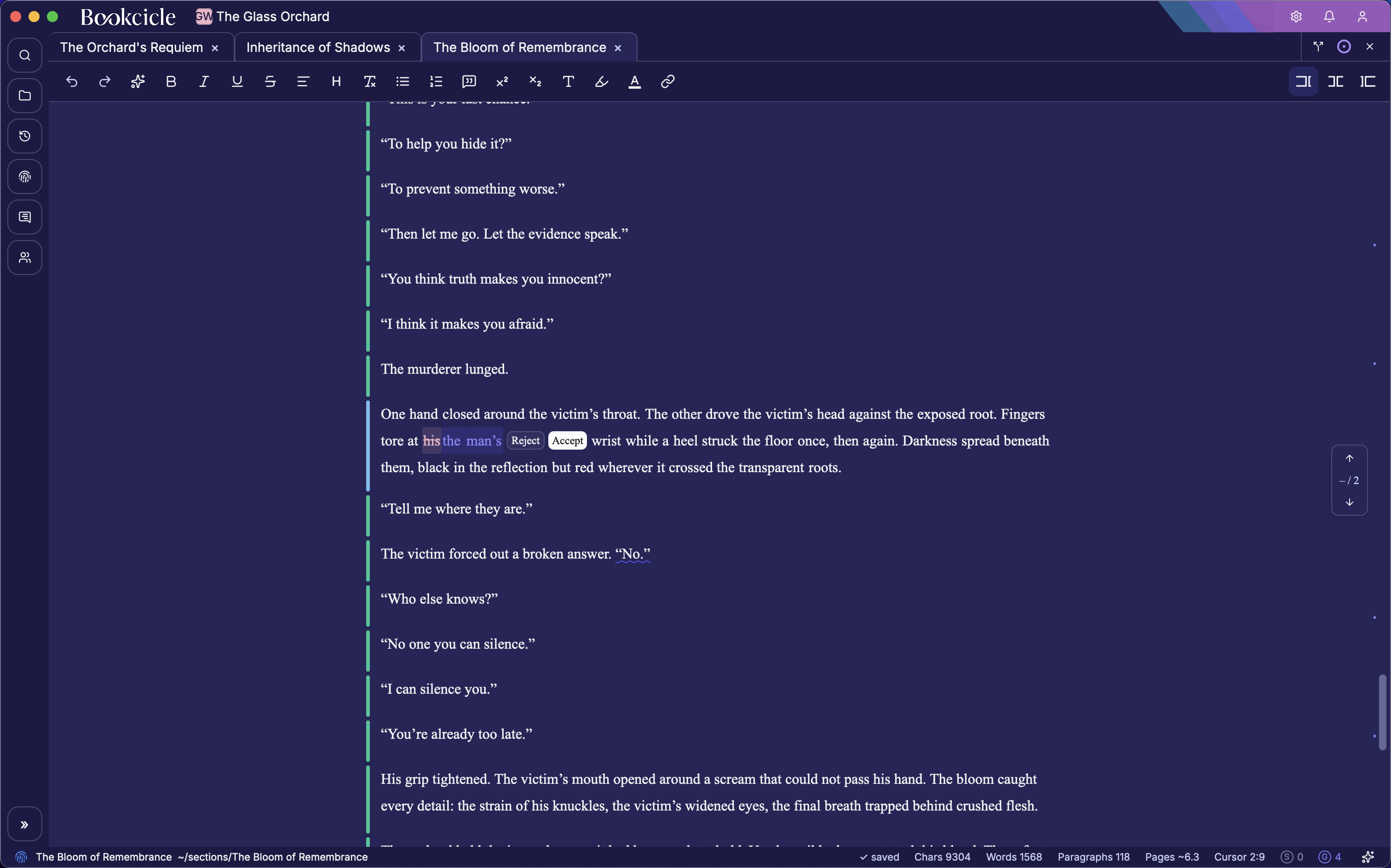
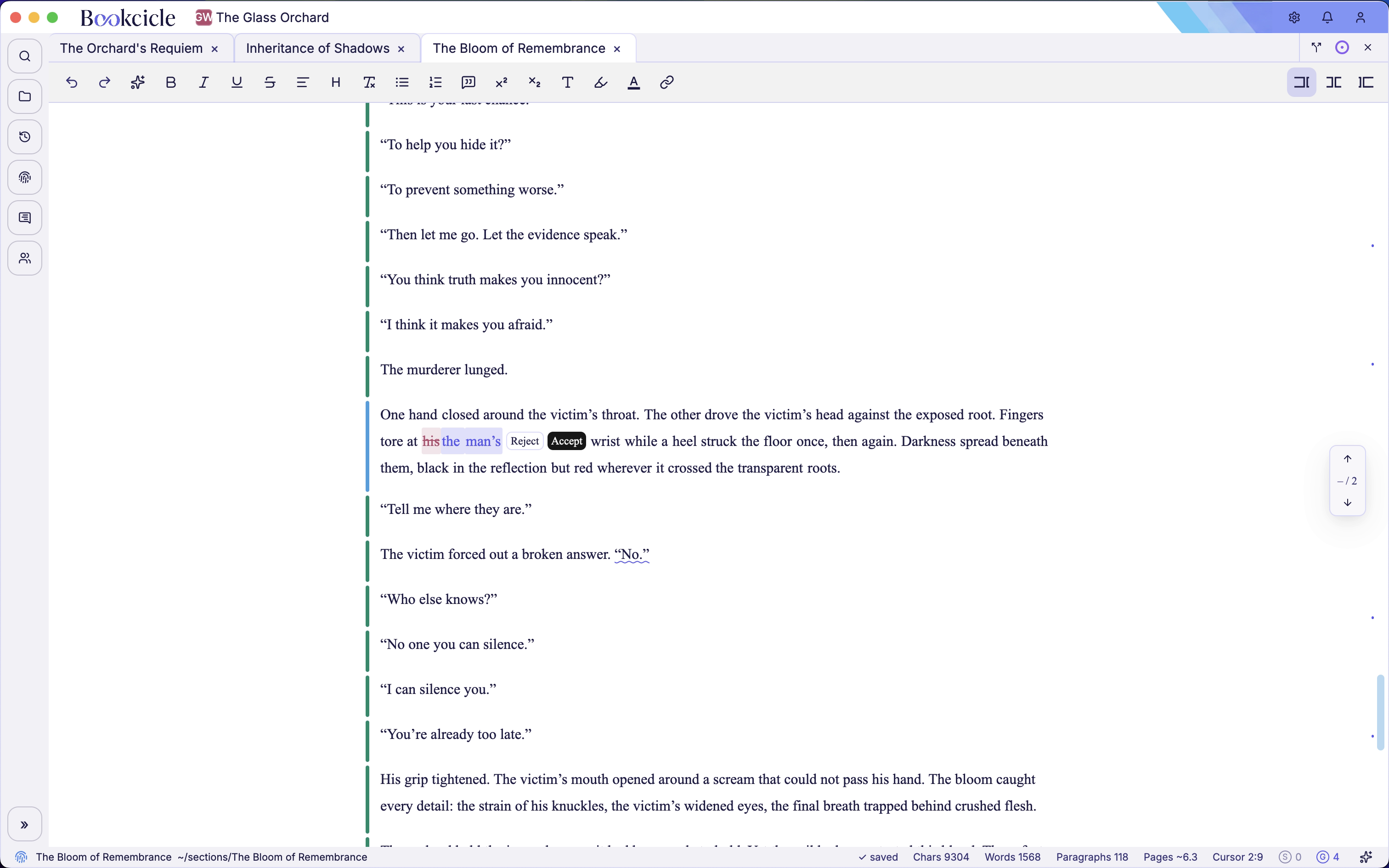
Andrew drafts and revises The Fragment Murder in a Bookcicle project. When he saves important snapshots or exports a delivery artifact, Notary can create a browser-local proof and attach receipt metadata to the project history.
For higher-value milestones, Bookcicle can attest the local receipt in the cloud and optionally anchor the signature publicly. If a dispute ever occurs, he can export a .bkclp capsule and share it for independent verification.
An author sends a manuscript section to a freelance editor for revisions. Before and after the handoff, each party creates their own proof records. The author can prove what was delivered, while the editor can prove what was received, changed, and returned.
This creates clean provenance around revisions without depending on screenshots, email timestamps alone, or disputed version histories. Each side has independently verifiable receipts for their role in the workflow.
A creator drafts source material locally, then runs AI-based transforms such as restructuring, language cleanup, or guided expansion. Notary can create proof points around the original source, the transformed output, and the delivery milestone.
When later asked how the work was produced, the creator has a more defensible provenance trail: what existed first, what was transformed, and what was ultimately delivered or published.